Selasa, 22 Desember 2009

Teeth Loss Since Berlusconi Statues

Milan: The incident that happened to the Prime Minister of Italy Silvio Berlusconi in Milan, Italy, is still making headlines in various international media, Monday (14/12). It turned out that the cause of collapse of the two teeth owner AC Milan football team is throwing the statue.

So far, no known intention of the perpetrators of acts that allegedly suffered from a mental disorder that. Meanwhile, Berlusconi's 73-year-old was treated in hospital. In addition to losing two teeth, the hospital said if the man who became a public controversy that has fractured the bone of his nose [read: attacks against Berlusconi's motives Not Known].

In December last year, U.S. President George Bush's star-like. In a press conference in Baghdad, Iraqi journalist named Al Zeidi throw shoes at Bush. It was an expression of the reporter resentment against Bush's policies that make Iraq even more alarming conditions.

Minggu, 20 Desember 2009

Threaten kill Obama, the U.S. Men's Prison was sentenced to 3 Years

U.S. federal court sentenced a man in jail to the U.S. for threatening to kill U.S. President Barack Obama. 21-year-old man was sentenced to three years in prison.

Nathan Wine has sent threatening e-mail on November 5, 2008. Or the day after Obama wins the U.S. presidential election. In the email was written "Obama will be blood splattered on the street".

Such as reported by Reuters news agency on Saturday (19/12/2009).

To the judge in Tampa, Florida, a man from Florida was claimed to have email sent to the Army Recruiting Command U.S.. Wine admitted that he wrote the email as a threat of assassination. But the young man did not mention the motive threat.

"I'm not going to calm down before this tyrant Americans shot. Blood was splattered at Obama will be the streets of DC," writes the Wine of the threat letter.

On doing so and threatened Wine maximum prison sentence of five years. But the judge sentenced 3 years in prison.

Kamis, 10 Desember 2009

Jakarta protests rocked the World Anti-Corruption Day

Jakarta - A number of demonstrations will take place in the capital Jakarta on the very day anti-corruption worldwide. It is estimated that thousands of people will do demonstrations. Careful stuck!

Launched from the site Traffic Management Center (TMC) Polda Metro, Wednesday (9/12/2009), a number of places would disambangi rallies.

Among demonstrations will take place in front of the Presidential Palace on Jl Medan Merdeka Utara, Central Jakarta began at 09.00 am. The protest will also take the Vice Presidential Palace began at 10:00 am.

A similar action will occur in the House of Representatives Jl Gatot Subroto from 08.00 pm. KPK building on Jl HR Rasuna Said, Kuningan also did not escape the protests that began at 09.00 am. The protest will also take place at Police Headquarters Jl Trunojoyo, South Jakarta began at 10:00 am.

Meanwhile, a number of elements including the Civil Society Coalition Against Corruption (Compact) and Indonesia Net Movement (GiB) will mobilize the masses to ensure relevant anti-corruption worldwide anniversary which fell on 9 December.

Mass action which was estimated at thousands of people are likely to be crowded areas Monument, Presidential Palace, and Bundaran HI.

Selasa, 08 Desember 2009

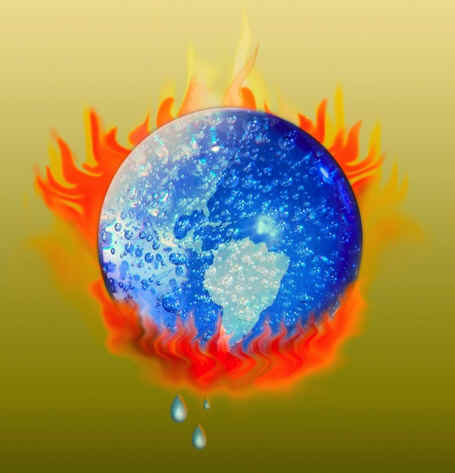
Global warming

Global warming is the increase in the average temperature of the Earth's near-surface air and oceans since the mid-20th century and its projected continuation. Global surface temperature increased 0.74 ± 0.18 °C (1.33 ± 0.32 °F) between the start and the end of the 20th century.[1][A] The Intergovernmental Panel on Climate Change (IPCC) concludes that most of the observed temperature increase since the middle of the 20th century was caused by increasing concentrations of greenhouse gases resulting from human activity such as fossil fuel burning and deforestation.[1] The IPCC also concludes that variations in natural phenomena such as solar radiation and volcanoes produced most of the warming from pre-industrial times to 1950 and had a small cooling effect afterward.[2][3] These basic conclusions have been endorsed by more than 40 scientific societies and academies of science,[B] including all of the national academies of science of the major industrialized countries.[4]

Climate model projections summarized in the latest IPCC report indicate that the global surface temperature will probably rise a further 1.1 to 6.4 °C (2.0 to 11.5 °F) during the twenty-first century.[1] The uncertainty in this estimate arises from the use of models with differing sensitivity to greenhouse gas concentrations and the use of differing estimates of future greenhouse gas emissions. Some other uncertainties include how warming and related changes will vary from region to region around the globe. Most studies focus on the period up to the year 2100. However, warming is expected to continue beyond 2100 even if emissions stop, because of the large heat capacity of the oceans and the long lifetime of carbon dioxide in the atmosphere.[5][6]

An increase in global temperature will cause sea levels to rise and will change the amount and pattern of precipitation, probably including expansion of subtropical deserts.[7] The continuing retreat of glaciers, permafrost and sea ice is expected, with warming being strongest in the Arctic. Other likely effects include increases in the intensity of extreme weather events, species extinctions, and changes in agricultural yields.

Political and public debate continues regarding climate change, and what actions (if any) to take in response. The available options are mitigation to reduce further emissions; adaptation to reduce the damage caused by warming; and, more speculatively, geoengineering to reverse global warming. Most national governments have signed and ratified the Kyoto Protocol aimed at reducing greenhouse gas emissions.

Temperature changes
Main article: Temperature record
Two millennia of mean surface temperatures according to different reconstructions, each smoothed on a decadal scale. The unsmoothed, annual value for 2004 is also plotted for reference.

The most commonly discussed measure of global warming is the trend in globally averaged temperature near the Earth's surface. Expressed as a linear trend, this temperature rose by 0.74°C ±0.18°C over the period 1906–2005. The rate of warming over the last half of that period was almost double that for the period as a whole (0.13°C ±0.03°C per decade, versus 0.07°C ± 0.02°C per decade). The urban heat island effect is estimated to account for about 0.002 °C of warming per decade since 1900.[8] Temperatures in the lower troposphere have increased between 0.12 and 0.22 °C (0.22 and 0.4 °F) per decade since 1979, according to satellite temperature measurements. Temperature is believed to have been relatively stable over the one or two thousand years before 1850, with regionally-varying fluctuations such as the Medieval Warm Period or the Little Ice Age.

Based on estimates by NASA's Goddard Institute for Space Studies, 2005 was the warmest year since reliable, widespread instrumental measurements became available in the late 1800s, exceeding the previous record set in 1998 by a few hundredths of a degree.[9] Estimates prepared by the World Meteorological Organization and the Climatic Research Unit concluded that 2005 was the second warmest year, behind 1998.[10][11] Temperatures in 1998 were unusually warm because the strongest El NiƱo in the past century occurred during that year.[12] Global temperature is subject to short-term fluctuations that overlay long term trends and can temporarily mask them. The relative stability in temperature from 1999 to 2009 is consistent with such an episode.[13][14]

Temperature changes vary over the globe. Since 1979, land temperatures have increased about twice as fast as ocean temperatures (0.25 °C per decade against 0.13 °C per decade).[15] Ocean temperatures increase more slowly than land temperatures because of the larger effective heat capacity of the oceans and because the ocean loses more heat by evaporation.[16] The Northern Hemisphere warms faster than the Southern Hemisphere because it has more land and because it has extensive areas of seasonal snow and sea-ice cover subject to ice-albedo feedback. Although more greenhouse gases are emitted in the Northern than Southern Hemisphere this does not contribute to the difference in warming because the major greenhouse gases persist long enough to mix between hemispheres.[17]

The thermal inertia of the oceans and slow responses of other indirect effects mean that climate can take centuries or longer to adjust to changes in forcing. Climate commitment studies indicate that even if greenhouse gases were stabilized at 2000 levels, a further warming of about 0.5 °C (0.9 °F) would still occur.[18]
Radiative forcing
Main article: Radiative forcing

External forcing is a term used in climate science for processes external to the climate system (though not necessarily external to Earth). Climate responds to several types of external forcing, such as changes in greenhouse gas concentrations, changes in solar luminosity, volcanic eruptions, and variations in Earth's orbit around the Sun.[2] Attribution of recent climate change focuses on the first three types of forcing. Orbital cycles vary slowly over tens of thousands of years and thus are too gradual to have caused the temperature changes observed in the past century.
Greenhouse gases
Main articles: Greenhouse gas and Greenhouse effect
Greenhouse effect schematic showing energy flows between space, the atmosphere, and earth's surface. Energy exchanges are expressed in watts per square meter (W/m2).

Recent atmospheric carbon dioxide (CO2) increases. Monthly CO2 measurements display seasonal oscillations in overall yearly uptrend; each year's maximum occurs during the Northern Hemisphere's late spring, and declines during its growing season as plants remove some atmospheric CO2.

The greenhouse effect is the process by which absorption and emission of infrared radiation by gases in the atmosphere warm a planet's lower atmosphere and surface. It was discovered by Joseph Fourier in 1824 and was first investigated quantitatively by Svante Arrhenius in 1896.[19] Existence of the greenhouse effect as such is not disputed, even by those who do not agree that the recent temperature increase is attributable to human activity. The question is instead how the strength of the greenhouse effect changes when human activity increases the concentrations of greenhouse gases in the atmosphere.

Naturally occurring greenhouse gases have a mean warming effect of about 33 °C (59 °F).[20][C] The major greenhouse gases are water vapor, which causes about 36–70 percent of the greenhouse effect; carbon dioxide (CO2), which causes 9–26 percent; methane (CH4), which causes 4–9 percent[not in citation given]; and ozone (O3), which causes 3–7 percent.[21][22] Clouds also affect the radiation balance, but they are composed of liquid water or ice and so are considered separately from water vapor and other gases.

Human activity since the Industrial Revolution has increased the amount of greenhouse gases in the atmosphere, leading to increased radiative forcing from CO2, methane, tropospheric ozone, CFCs and nitrous oxide. The concentrations of CO2 and methane have increased by 36% and 148% respectively since the mid-1700s.[23] These levels are much higher than at any time during the last 650,000 years, the period for which reliable data has been extracted from ice cores.[24] Less direct geological evidence indicates that CO2 values this high were last seen about 20 million years ago.[25] Fossil fuel burning has produced about three-quarters of the increase in CO2 from human activity over the past 20 years. Most of the rest is due to land-use change, particularly deforestation.[26]

CO2 concentrations are continuing to rise due to burning of fossil fuels and land-use change. The future rate of rise will depend on uncertain economic, sociological, technological, and natural developments. Accordingly, the IPCC Special Report on Emissions Scenarios gives a wide range of future CO2 scenarios, ranging from 541 to 970 ppm by the year 2100.[27] Fossil fuel reserves are sufficient to reach these levels and continue emissions past 2100 if coal, tar sands or methane clathrates are extensively exploited.[28]

The destruction of stratospheric ozone by chlorofluorocarbons is sometimes mentioned in relation to global warming. Although there are a few areas of linkage, the relationship between the two is not strong. Reduction of stratospheric ozone has a cooling influence, but substantial ozone depletion did not occur until the late 1970s.[29] Tropospheric ozone contributes to surface warming.[30]
Aerosols and soot
Ship tracks over the Atlantic Ocean on the east coast of the United States. The climatic impacts from aerosol forcing could have a large effect on climate through the indirect effect.

Global dimming, a gradual reduction in the amount of global direct irradiance at the Earth's surface, has partially counteracted global warming from 1960 to the present.[31] The main cause of this dimming is aerosols produced by volcanoes and pollutants. These aerosols exert a cooling effect by increasing the reflection of incoming sunlight. James Hansen and colleagues have proposed that the effects of the products of fossil fuel combustion—CO2 and aerosols—have largely offset one another in recent decades, so that net warming has been driven mainly by non-CO2 greenhouse gases.[32]

In addition to their direct effect by scattering and absorbing solar radiation, aerosols have indirect effects on the radiation budget.[33] Sulfate aerosols act as cloud condensation nuclei and thus lead to clouds that have more and smaller cloud droplets. These clouds reflect solar radiation more efficiently than clouds with fewer and larger droplets.[34] This effect also causes droplets to be of more uniform size, which reduces growth of raindrops and makes the cloud more reflective to incoming sunlight.[35]

Soot may cool or warm, depending on whether it is airborne or deposited. Atmospheric soot aerosols directly absorb solar radiation, which heats the atmosphere and cools the surface. Regionally (but not globally), as much as 50% of surface warming due to greenhouse gases may be masked by atmospheric brown clouds.[36] When deposited, especially on glaciers or on ice in arctic regions, the lower surface albedo can also directly heat the surface.[37] The influences of aerosols, including black carbon, are most pronounced in the tropics and sub-tropics, particularly in Asia, while the effects of greenhouse gases are dominant in the extratropics and southern hemisphere.[38]
Solar variation
Main article: Solar variation
Solar variation over the last thirty years.

Variations in solar output have been the cause of past climate changes,[39] but solar forcing is generally thought to be too small to account for a significant part of global warming in recent decades.[40][41] However, a recent phenomenological analysis indicates that the contribution of solar forcing may be underestimated.[42]

Greenhouse gases and solar forcing affect temperatures in different ways. While both increased solar activity and increased greenhouse gases are expected to warm the troposphere, an increase in solar activity should warm the stratosphere while an increase in greenhouse gases should cool the stratosphere.[2] Observations show that temperatures in the stratosphere have been steady or cooling since 1979, when satellite measurements became available. Radiosonde (weather balloon) data from the pre-satellite era show cooling since 1958, though there is greater uncertainty in the early radiosonde record.[43]

A related hypothesis, proposed by Henrik Svensmark, is that magnetic activity of the sun deflects cosmic rays that may influence the generation of cloud condensation nuclei and thereby affect the climate.[44] Other research has found no relation between warming in recent decades and cosmic rays.[45][46] A recent study concluded that the influence of cosmic rays on cloud cover is about a factor of 100 lower than needed to explain the observed changes in clouds or to be a significant contributor to present-day climate change.[47]
Feedback
Main article: Effects of global warming

A positive feedback is a process that amplifies some change. Thus, when a warming trend results in effects that induce further warming, the result is a positive feedback; when the warming results in effects that reduce the original warming, the result is a negative feedback. The main positive feedback in global warming involves the tendency of warming to increase the amount of water vapor in the atmosphere. The main negative feedback in global warming is the effect of temperature on emission of infrared radiation: as the temperature of a body increases, the emitted radiation increases with the fourth power of its absolute temperature.

Water vapor feedback
If the atmosphere is warmed, the saturation vapor pressure increases, and the amount of water vapor in the atmosphere will tend to increase. Since water vapor is a greenhouse gas, the increase in water vapor content makes the atmosphere warm further; this warming causes the atmosphere to hold still more water vapor (a positive feedback), and so on until other processes stop the feedback loop. The result is a much larger greenhouse effect than that due to CO2 alone. Although this feedback process causes an increase in the absolute moisture content of the air, the relative humidity stays nearly constant or even decreases slightly because the air is warmer.[48]
Cloud feedback
Warming is expected to change the distribution and type of clouds. Seen from below, clouds emit infrared radiation back to the surface, and so exert a warming effect; seen from above, clouds reflect sunlight and emit infrared radiation to space, and so exert a cooling effect. Whether the net effect is warming or cooling depends on details such as the type and altitude of the cloud. These details were poorly observed before the advent of satellite data and are difficult to represent in climate models.[48]
Lapse rate
The atmosphere's temperature decreases with height in the troposphere. Since emission of infrared radiation varies with temperature, longwave radiation escaping to space from the relatively cold upper atmosphere is less than that emitted toward the ground from the lower atmosphere. Thus, the strength of the greenhouse effect depends on the atmosphere's rate of temperature decrease with height. Both theory and climate models indicate that global warming will reduce the rate of temperature decrease with height, producing a negative lapse rate feedback that weakens the greenhouse effect. Measurements of the rate of temperature change with height are very sensitive to small errors in observations, making it difficult to establish whether the models agree with observations.[49]
Ice-albedo feedback
Aerial photograph showing a section of sea ice. The lighter blue areas are melt ponds and the darkest areas are open water, both have a lower albedo than the white sea ice. The melting ice contributes to ice-albedo feedback.
When ice melts, land or open water takes its place. Both land and open water are on average less reflective than ice and thus absorb more solar radiation. This causes more warming, which in turn causes more melting, and this cycle continues.[50]
Arctic methane release
Warming is also the triggering variable for the release of methane in the arctic.[51] Methane released from thawing permafrost such as the frozen peat bogs in Siberia, and from methane clathrate on the sea floor, creates a positive feedback.[52]
Reduced absorption of CO2 by the oceanic ecosystems
Ocean ecosystems' ability to sequester carbon is expected to decline as the oceans warm. This is because warming reduces the nutrient levels of the mesopelagic zone (about 200 to 1000 m deep), which limits the growth of diatoms in favor of smaller phytoplankton that are poorer biological pumps of carbon.[53]
CO2 release from oceans
Cooler water can absorb more CO2. As ocean temperatures rise some of this CO2 will be released. This is one of the main reasons why atmospheric CO2 is lower during an ice age. There is a greater mass of CO2 contained in the oceans than there is in the atmosphere.
Gas release
Release of gases of biological origin may be affected by global warming, but research into such effects is at an early stage. Some of these gases, such as nitrous oxide released from peat, directly affect climate.[54] Others, such as dimethyl sulfide released from oceans, have indirect effects.[55]

Climate models
Main article: Global climate model
Calculations of global warming prepared in or before 2001 from a range of climate models under the SRES A2 emissions scenario, which assumes no action is taken to reduce emissions and regionally divided economic development.

The geographic distribution of surface warming during the 21st century calculated by the HadCM3 climate model if a business as usual scenario is assumed for economic growth and greenhouse gas emissions. In this figure, the globally averaged warming corresponds to 3.0 °C (5.4 °F).

The main tools for projecting future climate changes are mathematical models based on physical principles including fluid dynamics, thermodynamics and radiative transfer. Although they attempt to include as many processes as possible, simplifications of the actual climate system are inevitable because of the constraints of available computer power and limitations in knowledge of the climate system. All modern climate models are in fact combinations of models for different parts of the Earth. These include an atmospheric model for air movement, temperature, clouds, and other atmospheric properties; an ocean model that predicts temperature, salt content, and circulation of ocean waters; models for ice cover on land and sea; and a model of heat and moisture transfer from soil and vegetation to the atmosphere. Some models also include treatments of chemical and biological processes.[56] Warming due to increasing levels of greenhouse gases is not an assumption of the models; rather, it is an end result from the interaction of greenhouse gases with radiative transfer and other physical processes in the models.[57] Although much of the variation in model outcomes depends on the greenhouse gas emissions used as inputs, the temperature effect of a specific greenhouse gas concentration (climate sensitivity) varies depending on the model used. The representation of clouds is one of the main sources of uncertainty in present-generation models.[58]

Global climate model projections of future climate most often have used estimates of greenhouse gas emissions from the IPCC Special Report on Emissions Scenarios (SRES). In addition to human-caused emissions, some models also include a simulation of the carbon cycle; this generally shows a positive feedback, though this response is uncertain. Some observational studies also show a positive feedback.[59][60][61] Including uncertainties in future greenhouse gas concentrations and climate sensitivity, the IPCC anticipates a warming of 1.1 °C to 6.4 °C (2.0 °F to 11.5 °F) by the end of the 21st century, relative to 1980–1999.[1]

Models are also used to help investigate the causes of recent climate change by comparing the observed changes to those that the models project from various natural and human-derived causes. Although these models do not unambiguously attribute the warming that occurred from approximately 1910 to 1945 to either natural variation or human effects, they do indicate that the warming since 1970 is dominated by man-made greenhouse gas emissions.[62]

The physical realism of models is tested by examining their ability to simulate current or past climates.[63] Current climate models produce a good match to observations of global temperature changes over the last century, but do not simulate all aspects of climate.[26] Not all effects of global warming are accurately predicted by the climate models used by the IPCC. For example, observed Arctic shrinkage has been faster than that predicted.[64]
Attributed and expected effects
Environmental
Main articles: Effects of global warming and Regional effects of global warming
Sparse records indicate that glaciers have been retreating since the early 1800s. In the 1950s measurements began that allow the monitoring of glacial mass balance, reported to the WGMS and the NSIDC.

It is usually impossible to connect specific weather events to global warming. Instead, global warming is expected to cause changes in the overall distribution and intensity of events, such as changes to the frequency and intensity of heavy precipitation. Broader effects are expected to include glacial retreat, Arctic shrinkage, and worldwide sea level rise. Some effects on both the natural environment and human life are, at least in part, already being attributed to global warming. A 2001 report by the IPCC suggests that glacier retreat, ice shelf disruption such as that of the Larsen Ice Shelf, sea level rise, changes in rainfall patterns, and increased intensity and frequency of extreme weather events are attributable in part to global warming.[65] Other expected effects include water scarcity in some regions and increased precipitation in others, changes in mountain snowpack, and some adverse health effects from warmer temperatures.[66]

Social and economic effects of global warming may be exacerbated by growing population densities in affected areas. Temperate regions are projected to experience some benefits, such as fewer cold-related deaths.[67] A summary of probable effects and recent understanding can be found in the report made for the IPCC Third Assessment Report by Working Group II.[65] The newer IPCC Fourth Assessment Report summary reports that there is observational evidence for an increase in intense tropical cyclone activity in the North Atlantic Ocean since about 1970, in correlation with the increase in sea surface temperature (see Atlantic Multidecadal Oscillation), but that the detection of long-term trends is complicated by the quality of records prior to routine satellite observations. The summary also states that there is no clear trend in the annual worldwide number of tropical cyclones.[1]

Additional anticipated effects include sea level rise of 0.18 to 0.59 meters (0.59 to 1.9 ft) in 2090–2100 relative to 1980–1999,[1] new trade routes resulting from arctic shrinkage,[68] possible thermohaline circulation slowing, increasingly intense (but less frequent) hurricanes and extreme weather events,[69] reductions in the ozone layer, changes in agriculture yields, changes in the range of climate-dependent disease vectors,[70] which have been linked to increases in the prevalence of malaria and dengue fever,[71] and ocean oxygen depletion.[72] Increased atmospheric CO2 increases the amount of CO2 dissolved in the oceans.[73] CO2 dissolved in the ocean reacts with water to form carbonic acid, resulting in ocean acidification. Ocean surface pH is estimated to have decreased from 8.25 near the beginning of the industrial era to 8.14 by 2004,[74] and is projected to decrease by a further 0.14 to 0.5 units by 2100 as the ocean absorbs more CO2.[1][75] Heat and carbon dioxide trapped in the oceans may still take hundreds of years to be re-emitted, even after greenhouse gas emissions are eventually reduced.[6] Since organisms and ecosystems are adapted to a narrow range of pH, this raises extinction concerns and disruptions in food webs.[76] One study predicts 18% to 35% of a sample of 1,103 animal and plant species would be extinct by 2050, based on future climate projections.[77] However, few mechanistic studies have documented extinctions due to recent climate change,[78] and one study suggests that projected rates of extinction are uncertain.[79]
Economic
Main articles: Economics of global warming and Low-carbon economy
Projected temperature increase for a range of stabilization scenarios (the colored bands). The black line in middle of the shaded area indicates 'best estimates'; the red and the blue lines the likely limits. From IPCC AR4.

The IPCC reports the aggregate net economic costs of damages from climate change globally (discounted to the specified year). In 2005, the average social cost of carbon from 100 peer-reviewed estimates is US$12 per tonne of CO2, but range -$3 to $95/tCO2. The IPCC's gives these cost estimates with the caveats, "Aggregate estimates of costs mask significant differences in impacts across sectors, regions and populations and very likely underestimate damage costs because they cannot include many non-quantifiable impacts."[80]

One widely publicized report on potential economic impact is the Stern Review, written by Sir Nicholas Stern. It suggests that extreme weather might reduce global gross domestic product by up to one percent, and that in a worst-case scenario global per capita consumption could fall by the equivalent of 20 percent.[81] The response to the Stern Review was mixed. The Review's methodology, advocacy and conclusions were criticized by several economists, including Richard Tol, Gary Yohe,[82] Robert Mendelsohn[83] and William Nordhaus.[84] Economists that have generally supported the Review include Terry Barker,[85] William Cline,[86] and Frank Ackerman.[87] According to Barker, the costs of mitigating climate change are 'insignificant' relative to the risks of unmitigated climate change.[88]

According to United Nations Environment Programme (UNEP), economic sectors likely to face difficulties related to climate change include banks, agriculture, transport and others.[89] Developing countries dependent upon agriculture will be particularly harmed by global warming.[90]
Responses to global warming

The broad agreement among climate scientists that global temperatures will continue to increase has led some nations, states, corporations and individuals to implement responses. These responses to global warming can be divided into mitigation of the causes and effects of global warming, adaptation to the changing global environment, and geoengineering to reverse global warming.
Mitigation
Main article: Mitigation of global warming
Carbon capture and storage (CCS) is an approach to mitigation. Emissions may be sequestered from fossil fuel power plants, or removed during processing in hydrogen production. When used on plants, it is known as bio-energy with carbon capture and storage.

Mitigation of global warming is accomplished through reductions in the rate of anthropogenic greenhouse gas release. Models suggest that mitigation can quickly begin to slow global warming, but that temperatures will appreciably decrease only after several centuries.[91] The world's primary international agreement on reducing greenhouse gas emissions is the Kyoto Protocol, an amendment to the UNFCCC negotiated in 1997. The Protocol now covers more than 160 countries and over 55 percent of global greenhouse gas emissions.[92] As of June 2009, only the United States, historically the world's largest emitter of greenhouse gases, has refused to ratify the treaty. The treaty expires in 2012. International talks began in May 2007 on a future treaty to succeed the current one.[93] UN negotiations are now gathering pace in advance of a meeting in Copenhagen in December 2009.[94]

Many environmental groups encourage individual action against global warming, as well as community and regional actions. Others have suggested a quota on worldwide fossil fuel production, citing a direct link between fossil fuel production and CO2 emissions.[95][96]

There has also been business action on climate change, including efforts to improve energy efficiency and limited moves towards use of alternative fuels. In January 2005 the European Union introduced its European Union Emission Trading Scheme, through which companies in conjunction with government agree to cap their emissions or to purchase credits from those below their allowances. Australia announced its Carbon Pollution Reduction Scheme in 2008. United States President Barack Obama has announced plans to introduce an economy-wide cap and trade scheme.[97]

The IPCC's Working Group III is responsible for crafting reports on mitigation of global warming and the costs and benefits of different approaches. The 2007 IPCC Fourth Assessment Report concludes that no one technology or sector can be completely responsible for mitigating future warming. They find there are key practices and technologies in various sectors, such as energy supply, transportation, industry, and agriculture, that should be implemented to reduced global emissions. They estimate that stabilization of carbon dioxide equivalent between 445 and 710 ppm by 2030 will result in between a 0.6 percent increase and three percent decrease in global gross domestic product.[98]
Adaptation
Main article: Adaptation to global warming

A wide variety of measures have been suggested for adaptation to global warming. These measures range from the trivial, such as the installation of air-conditioning equipment, to major infrastructure projects, such as abandoning settlements threatened by sea level rise.

Measures including water conservation,[99] water rationing, adaptive agricultural practices,[100] construction of flood defences,[101] Martian colonization,[102] changes to medical care,[103] and interventions to protect threatened species[104] have all been suggested. A wide-ranging study of the possible opportunities for adaptation of infrastructure has been published by the Institute of Mechanical Engineers.[105]
Geoengineering
Main article: Geoengineering

Geoengineering is the deliberate modification of Earth's natural environment on a large scale to suit human needs.[106] An example is greenhouse gas remediation, which removes greenhouse gases from the atmosphere, usually through carbon sequestration techniques such as carbon dioxide air capture.[107] Solar radiation management reduces absorbed solar radiation, such as by the addition of stratospheric sulfur aerosols[108] or cool roof techniques.[109] No large-scale geoengineering projects have yet been undertaken.
Debate and skepticism
Main articles: Global warming controversy and Politics of global warming
See also: Scientific opinion on climate change and Climate change denial
Per capita greenhouse gas emissions in 2000, including land-use change.

Per country greenhouse gas emissions in 2000, including land-use change.

Increased publicity of the scientific findings surrounding global warming has resulted in political and economic debate.[110] Poor regions, particularly Africa, appear at greatest risk from the projected effects of global warming, while their emissions have been small compared to the developed world.[111] The exemption of developing countries from Kyoto Protocol restrictions has been used to justify non-ratification by the U.S. and a previous Australian Government.[112] (Australia has since ratified the Kyoto protocol.)[113] Another point of contention is the degree to which emerging economies such as India and China should be expected to constrain their emissions.[114] The U.S. contends that if it must bear the cost of reducing emissions, then China should do the same[115][116] since China's gross national CO2 emissions now exceed those of the U.S.[117][118][119] China has contended that it is less obligated to reduce emissions since its per capita responsibility and per capita emissions are less that of the U.S.[120] India, also exempt, has made similar contentions.[121]

In 2007–2008 Gallup Polls surveyed 127 countries. Over a third of the world's population were unaware of global warming, with developing countries less aware than developed, and Africa the least aware. Of those aware, Latin America leads in belief that temperature changes are a result of human activities while Africa, parts of Asia and the Middle East, and a few countries from the Former Soviet Union lead in the opposite belief.[122] In the western world, the concept and the appropriate responses are contested. Nick Pidgeon of Cardiff University finds that "results show the different stages of engagement about global warming on each side of the Atlantic"; where Europe debates the appropriate responses while the United States debates whether climate change is happening.[123]

Debates weigh the benefits of limiting industrial emissions of greenhouse gases against the costs that such changes would entail.[98] Using economic incentives, alternative and renewable energy have been promoted to reduce emissions while building infrastructure.[124][125] Business-centered organizations such as the Competitive Enterprise Institute, conservative commentators, and companies such as ExxonMobil have downplayed IPCC climate change scenarios, funded scientists who disagree with the scientific consensus, and provided their own projections of the economic cost of stricter controls.[126][127][128][129] Environmental organizations and public figures have emphasized changes in the current climate and the risks they entail, while promoting adaptation to changes in infrastructural needs and emissions reductions.[130] Some fossil fuel companies have scaled back their efforts in recent years,[131] or called for policies to reduce global warming.[132]

Some global warming skeptics in the science or political communities dispute all or some of the global warming scientific consensus, questioning whether global warming is actually occurring, whether human activity has contributed significantly to the warming, and the magnitude of the threat posed by global warming. Prominent global warming skeptics include Richard Lindzen, Fred Singer, Patrick Michaels, John Christy, Stephen McIntyre and Robert Balling.

Minggu, 06 Desember 2009

Hadi Utomo: Removal Marzuki Alie Match Rules

Jakarta: Democratic Party (PD) argue Marzuki Alie was removed from his position as general secretary of the party chairman often bypassing the government party. Speaker of the House was replaced by the rules because the party cadres who held public office should be removed at the party office. Marzuki's position will be filled later Amir Syamsudin. As stated by Chairman Hadi Utomo PD on the sidelines of the National Meeting of World War III in Jakarta Convention Center (JCC), Senayan, Central Jakarta, Saturday (5 / 12).

As reported by the official site of PD, Hadi said, not just the Secretary General of the substituted PD. Chairman of the Regional Leadership Council and Chairman of PD Branch Executive Board elected as members of the Board also replaced. Substitution is a national policy to prevent PD positions, to better focus public office undergo

Jumat, 04 Desember 2009

Why The General Of Third World Fail In Politics

INTRODUCTION

The third world is a part of our earth that is always in the clutches of the military generals. Almost every general in this part of the earth is ambitious to grab the highest post of the president or chief martial law administrator. But wishes do not always come true. The golden bird does not sit on the shoulders of all the generals. Only few get the chance to rule and make the public of their states fool. There are a lot of such generals who do not succeed in usurping the powers.
and are not able to reach their "unnatural" political boundaries.

Why these generals fail in politics, let us make a survey of the causes and effects of their failure.

ATTITUDE

The first and foremost reason of the defeat in the battlefield of politics is the unreasonable attitude of the generals. Many generals attempt seriously to make good. They have native ability to do so. The native ability in this connection is the military background of the general. This general finds it almost impossible to sit at a desk and concentrate on his evil designs.

He cannot sit down for a long time due to some addiction or illness to ponder over the constitution. Sometimes he tries to do so, opens the book of constitution, but he is unable to decide about his abilities. He always procrastinates and the other rank fellows win the fields. He wastes his time in preparing himself to make a coup. In this way his time passes and nothing comes out in his favour.

Such habits are not easy to uproot. If the general wants to succeed he should have to eradicate such obnoxious habits otherwise he should shun all his noble designs of revolution.
Although he thinks that he is trying yet he does not try. He spends a lot of time in the presence of the books of constitution but is unable to amend it in his favour.

ADVISORS

A common cause of failure of the generals of the third world is mistaken ambition on the part of his advisors. The toadies and humbugs are always instigate the military chief to achieve the highest post but are not the best judge of the abilities of the general.
Many generals do not show any interest in political involvement. They are absolutely not fit for this job even for their own job but are advised by his advisor to get involved in the politics. Such a general cannot overthrow the elected government.

The reason behind this defeat is that he has to follow a direction mapped out by his advisor. That direction always runs counter to his interests and abilities.

Such generals always earn a number of warm enemies among the advisors and politicians. Their wish of making him a stooge does not come true and they become his enemies until they succeed in overthrowing him.
Such a general prefers to become ambassador or head of a lucrative department after retirement.

EASYGOING FELLOWS

Another type of a General who does not try is the very intelligent and diligent person .He has always done his duties efficiently and considers politics a child, s play. He supposes that he can float through the politics with as little effort as he did through military career. Such a general is the most pitiable person on the earth when he is pitted in the field of politics. It is almost a tragedy to see such a receptive mind wasting the entire opportunity the politics has offered to him.

PHYSICAL AND MENTAL HEALTH

The question of health both physical and mental is always one of the reasons for failure. If a proper free medical service is available in the USA or ENGLAND, the general can hold up the bridles of the administration. Moreover if proper cooperation exists between the establishment and the general he can easily make a coup.

FINANCIAL RESOURCES

Most of the generals want to join politics but the financial pressure is a very serious reason behind their failure. A lot of them could not find or avail opportunity to heap unlawful wealth during service. Such generals cannot succeed in their ambitions, as they can not gather timeservers around them. Such officers are unable to win sympathies of the establishment and politicians.

These generals are absolutely ignored by the patrons.

Moreover the generals who are cast entirely on their own resources cannot succeed because their entire income is not enough to grease the palms of the establishment. Politicians having vested interests should help them in this regard if they want to fulfil their interests.

JUDGMENT

There are a goodly number of generals whose judgment is perverted by the attraction of the motorcades and escorts of the prime ministers and presidents. So they want to overthrow them and fill up their gap. Such generals who aim at these things should shun their ideas of getting the status of a president or a prime minister .It is better for them to become chairman of a semi- governmental organization and lead their life in comfort and luxury.

POLITICS IS NOT CRICKET

A large number of generals drift into politics and drift out again without serving any interests. They think that politics are just like cricket. Most of them have not found any serious interest in politics. It is usually wise to let them retire in the cold world of general public so that they might know the real and miserable condition of the public.

CONCLUSION

In so far as the failure is concerned it can be avoided by acting upon the guidelines provided by the former military rulers. If this is not kept in mind the failure is the fate of such generals.
The advisors are advised to select the right general who follows the footsteps of his forerunners who had ruled the nation for a decade or more. It would be great service to the failing generals as well to the ignorant people who always welcome the person in the uniform.

Selasa, 01 Desember 2009

Commission Schedule Check Back Ary Muladi

VIVAnews - Corruption Eradication Commission (KPK) plans to re-examine Ary Muladi. Ary is one of the key witnesses in the case alleged against the criminalization of the KPK leadership Rianto Samad Seeds and Chandra M Hamzah.

The plan, Ary Muladi examination will take place at the Commission Building, Jalan HR Rasuna Said, South Jakarta, Tuesday, December 1, 2009. Examinations scheduled to begin approximately at 09.00.

This examination is still a series of further investigation that took place Monday, November 30 yesterday. When the examination yesterday, Ary Muladi dicecar 29 questions.

Ary admitted that he had answered openly. "My story is," said Ary Muladi after questioning as a witness for the alleged cases to Anggodo Widjojo, at the Commission office, Jakarta, Monday, November 30, 2009.

Ary lawyer Muladi, Sugeng Santoso said that his client answered about 29 questions from the Commission team. The question among others, about how the introduction of the Anggodo Widjojo Ary.

In addition, continued Sugeng, Ary also asked about the direction Anggodo to himself. The goal, to adjust the investigator with information on the chronology.

Then also about communication Anggodo to an investigator in the Criminal Investigation Body is heard by Ary. "Just until it was," said Sugeng, who accompanied his client.

Sabtu, 28 November 2009

Organisational Politics

Is Organization politics bad?

Whenever we hear the word politics - negative thoughts come up in almost everyone's mind. Politics becomes bad when there is hidden agenda, using power and influence to further your personal interests, maligning your colleagues etc. Following are examples of bad politics

  • Regional/language bias Well, let's accept this. We have a comfort feel if we have people from your region or who speak your language. Assume there are 2 people who have more or less the same competence. The person who is from the same region as the boss gets visibility, rewards, recognitions etc. Boss does the image building for this person and ignores the other person completely. So you could imagine the emotional state of other guy. Such issues could happen between peers at all levels.
  • Perception spreading/Image tarnishing Let's assume that an influential person has some perception about somebody or some thing. This person spreads his/her perception to other people. This could be done intentionally or unintentionally. But the damage it does is profound. If it is about a person, the person's career is jeopardized or if it is about the project, the project is bound to fail or people involved in that project will get de-motivated or even resign.
  • Hiding important information This point is self explanatory. Hiding important information which is required to do your work is most negative thing I can think of. The person hiding the information wants the other person to fail desperately for whatever reason.
  • Misrepresentation of information In order to protect one's image, the facts are misrepresented so that someone else's image is tarnished. Most of the times this person will not be present to defend himself/herself and gets to know only after his/her image is tarnished. In order to change this, the person will have to work hard for quite sometime. Very often it will be difficult to re-establish the good image depending on how influential the person is.
Is Organization politics good?

What is politics? In my experience it includes gossiping, networking etc. Every organization will have grape vine for rumors, gossips, speculation etc. Following are examples of good politics

  • Networking/friends The backbone of office politics is networking. Without network of colleagues there cannot be politics. Once you start networking with your colleagues you will get to know more about your colleagues, their interests, the projects they are working on, the problems they face etc. This has multiple benefits. You know where other projects are positioned; you get information needed for doing your job in a better way, or advancing your career, getting that etc. You will get to know the pulse of your organization by getting to know what is happening within the organization. Most of the time you never get important information from your bosses but from your network and you could prepare yourself for any eventuality. This is most important source of information.
  • Speculation For any controversial topic within organization, there will be speculation. Groups of people speculate on what will be the outcome of this topic and you get various insights into the topic. If it is about who will be next CEO or General Manager, you will get to know who the competent people in the company are. These kinds of speculation open up various possibilities and also offer insight into how your colleague's thought process works and more importantly it provides invaluable insight into their emotional setup. The speculation could be started by involved parties also, so as to direct the actual outcome to be what they expect it to be. I have seen this working.
  • Career development Little bit of politics will also help you to make advancements in career. You will get important information via networking/speculation regarding opportunities and new job openings. With this information you could position yourself based on your goals and contact the right person with right set of information. As and when you grow higher in hierarchy, the person has to be part of office politics to even retain his/her position or to grow further.
Summary
Most of what is discussed above is somewhat abstract, but this is what I have seen in many organizations that I worked for. To summarize, every organization will have politics and you should become part of it even if you like or dislike if you want career growth. Also one should cultivate good friendship and trust with at least some of your colleagues.On the other hand, senior leadership team should ensure that negative politics is not encouraged. It could bring down the organization itself.

Kamis, 26 November 2009

Barack Obama says American Alcohoilism is the Cause of Iraq War

According to Democratic Presidential candidate Senator Barack Obama, American Alcohoilism is the root cause of the Iraq War, soon to be the Iran War. The immense, gluttonous, ridiculous over consumption of oil by the people of the United States of America is the root cause of the Iraq War said Senator Barack Obama of Illinois.

At the time that America went to war in Iraq Senator Barack Obama was a state legislator. He opposed the war in Iraq from the beginning unlike all of the other leading candidates from both parties who voted to go to war in Iraq proving that the color of your skin and long years of experience do not always translate into good foresight and wisdom. Yesterday Barack Obama addressed the DNC Winter Meeting. Here is a part of what Barack Obama said:

“We’ve got 130,000 Americans fighting halfway across the world in a war that should never have been waged, led by leaders who have no plan to end it. The decisions that we make in the next decade will determine the future of our children and the future of our grandchildren. The campaign, our mission is to figure out how we can do some good for this precious country and planet of ours. Our oil dependence is threatening not just our pocketbooks but the safety of our planet.”

Barack Obama blasted President Bush’s new war escalation and budget which asks for the American people to throw another trillion dollars after bad for the war in Iraq. This warmongering by George Bush is bankrupting health care, social security, education and creating a deficit which will lead to the bankruptcy of the country, leading to another great depression or runaway inflation.

The root cause of the Iraq War and the American dependence on other countries for oil is not a lack of domestic oil but an insane over consumption of oil by the people of the United States. This graph is worth a billion words and shows in one glance the amount of oil used every day by every country on the planet earth. Look at it, click on it NOW to understand the root cause of the Iraq War. http://www.nationmaster.com/graph/ene_oil_con-energy-oil-consumption

The people of the United States of America consume 20 million barrels of oil each and every day, far in excess of any other nation on Earth. For the past 5 million years before a hundred years ago our ancestors used zero oil. Russia and India use 2 million barrels of oil per day. Indonesia with nearly the same population as the U.S. uses 1 million barrels of oil per day. Laos and many other countries use 3 thousand barrels of oil per day.

Now look at this chart of exports and production of oil by every country on Earth. http://en.wikipedia.org/wiki/Chart_of_exports_and_production_of_oil_by_nation This chart shows that Saudi Arabia exports 9 million barrels of oil more per day than it imports. On the other end of the scale the United States the world’s largest polluter by far imports 12 million barrels of oil per day on top of the 5 million barrels per day we produce domestically in the United States. The Iraq desert is capable of producing 2 million barrels of oil per day at a cost of $1 per barrel and this is why the United States invaded Iraq, to steal their oil. Every one of the 1.3 billion Muslim people on Earth knows this. The Iraq War and Iran War exit strategy is for the people of the United States of America to over the next year cut back on our ridiculous over consumption of oil to 2 million barrels of oil per day.

Russia and China consider Iran to be their own backyard. They are both going to back Iran just like they backed tiny North Vietnam to defeat the United States, when the United States attacks Iran. Russia and Iran have half of the world’s oil and Iran’s Supreme Leader Ayatollah Ali Khamenei and Russian President Vladimir Putin just announced their own gas OPEC. Russia, the Soviet Union, the long time enemy of the United States is building the Iranian nuclear reactor in Busheher Iran and the Soviet Union just delivered $1 billion worth of advanced surface to air missiles to Iran to protect it.

Yesterday Senator Barack Obama said, “Our oil dependence is threatening not just our pocketbooks but the safety of the planet.” The American dependence upon foreign oil because of our ridiculous over consumption of oil every day caused the Iraq War, is leading to the Iran War and then to nuclear world war 3, the extinction of life one earth in nuclear world war 3 and its aftermath nuclear winter then ultraviolet summer aka Mad, Mutually Assured Destruction. Furthermore the burning by the United States every day of 20 million barrels of oil, the American Alcohoilism is a leading cause of the impending global warming catastrophe when Antarctica, Greenland and the Arctic ice continents melt and the earth’s one Ocean rises permanently 50 feet, permanently submerging the United States under 50 feet of water. The United States is like a codeine addict thinking that the solution to his problems is to break into a drug store and steal the pills.

The real solution to our war and global warming problems is to eliminate our consumption of oil completely. Our ancestors did fine without it for five million years. Why are SUV’s legal? Why isn’t it a law that every American must drive a Smart Car or an electric car or an ethanol car which runs on corn or a fuel cell car which runs on water and emits only water vapor or ride a bicycle? Think of the reduction in oil consumption. Think of the end of the need to colonize the Middle East. Ford Motors is now approaching bankruptcy and Japanese Toyota just reported record sales and profit because of the difference in their cars’ gas mileage. Isn’t it about time that we as American people took the fifth step at Alcohoilics Anonymous and admitted to God, to ourselves and to everyone else the exact nature of our wrongs, that we drank too much oil, and isn’t it about time that we as Americans stopped needlessly drinking so much oil? Our very existence and the continued existence of life on Earth depends upon it said Senator Barack Obama yesterday. It’s just plain common sense. We know how much war costs in dollars and lives lost. How much money will peace save the American taxpayers, who are being taxed out of their minds by the hidden George Bush War Tax, which just went up another trillion dollars yesterday?

Senin, 23 November 2009

LSM Threatens Attack If SBY Ignore Palace Team 8


VIVAnews - A number of activists from various non-governmental organizations will hold a signature delivery action to President Susilo Bambang Yudhoyono as a form of support to follow up recommendations Eight team.

They would go around the Presidential Palace at 09.00 am, Monday, November 23, 2009. "We'll leave to the SBY thousands of signatures of support," said Director Ray Rangkuti Circle Madani, when contacted VIVAnews, Sunday evening, November 22, 2009.

Action is a form of support to the president for a recommendation from Tim menindaklajuti Verification Process Facts and Case Law Samad Riyanto Seeds and Chandra M Hamzah. "The attitude of the president to implement the recommendations that are awaited by the people," he said.

The President asked to implement all the recommended points Eight team. It shows decisiveness by the president to establish the rule of law. "Although the president was assessed attitudes slow in this case, but we hope there is a decisive action to solve it thoroughly," he said.

Action will continue to watch with my persiden answers on recommendation 8 in the Office team Imparsial, road Diponogoro, Menteng, Central Jakarta. President dijadwalka submit the answers on Monday night, 23 November 2009. "If the attitude of the president to ignore the recommendations Eight team, we'll do big action to the Palace," he said.

The activists who participate will melt in Indonesian Youth flag. They include Usman Hamid, Fadli Zon, director of Circle Madani (Lima), Ray Rangkuti; Muhamdiyah Youth Chairman, M Izzul Muslims; Secretary General of the Muslim Students Association, Ahmad Nasir; and Haris Rusly of Indonesian Youth Leadership Forum (FKPI).

In recommendation 31 yard thick, the team president of Eight request to stop the seed case and Chandra, completing Kabareskrim legal cases related Duadji Inspector Susno Century Bank case, repositioning of personnel in the conduct of law enforcement institutions, and the eradication of the body broker in the case of law enforcement institutions.

Jumat, 20 November 2009

Terrorism: How to End it

As human beings we have grown accustomed to dealing with problems too late. In fact we don’t even label things as “problems” until they become problematic enough to affect our lives negatively. A broken headlight is not a “problem” until it gets dark at night. A neglected child is not problematic until he commits his first crime or turns to drugs. An imbalance of national wealth is not a “problem” until very poor people steal your money so they can eat. In other words, we have become used to procrastinating and letting problematic situations build up. If you think about it, everything we label as a “problem” is not even the problem. They are all the consequences of those problems. A neglected child is the problem- not his drug abuse. An imbalance of wealth is the problem- not the crime on the streets.

Oddly enough we have decided that the best way to deal with problems is to deal with its consequences. A neglected child turning to drugs faces punishment for using drugs, but he’s still neglected. A poor man who steals a car faces jail time for his crime, but he’s still poor. What we are doing is not dealing with the root of any problem we face, but yet we pretend not only to understand it, but also to solve it. This is like cutting your grass really really short every week so the weeds stop coming back. You haven’t even tried to dig up the roots. We must stop dealing with the consequences of problems and begin by understanding the problems themselves. That is, of course, if we decide we want long-term solutions to problems and not just temporary fixes.

Now what does this have to do with Terrorism? After all, you are reading this because you wanted to know “How to End Terrorism” right? Well let’s say you are driving down the freeway and your car runs out of gas. You wouldn’t label this a “car problem” or a “driving problem” now would you? You needed gas, but yet you denied your precious machine the fuel that flows through its veins. How could you? Running out of gas was the consequence of your neglect (or cruelty, if you ask me). Now it’s too little too late, because you are already late for work. This, my friends, was a preventable situation. Terrorism too, is a preventable situation. When 9-11 happened I thought it would become a call to world education. I thought it would become a “hey look at your gas meter!” type of call for the US.

Unfortunately this call did not happen. We decided instead that understanding the problem was going to require too much effort and opted to go ahead and solve it. We opted to solve the problem we didn’t understand. Attack Revenge Attack. Who are the terrorists? Why did they do this? …who knows. In the few years that have followed those events we have been bombarded with assumptions and misconceptions regarding what “they” think. The 2-second attention span of the average US citizen can only hold the notion that “They hate us”. Why? How? For how long? Who knows. I tell you now that what drives this conflict, and every other one on this planet for that matter, is a subject Americans have learned to be very touchy about. That subject is belief. Belief is the gas that fuels this fire. It has political consequences, economic consequences, and causes war. We have to deal with belief to prevent its destructive consequences. We cannot solve a belief problem economically. We cannot solve a belief problem politically. We absolutely will NOT solve a belief problem through war.

Now before you throw your hands up in the air and say “How can we possibly deal with the beliefs of the entire world??” I tell you this: the United States of America is a place that now holds millions of people coexisting with other people of completely different backgrounds and beliefs. As a planet we now have a technology that connects the whole world in a way never before possible. Look around you skeptic, everything you see was at some point in history “impossible”. Let’s not make the foolish mistake of thinking that a united world is impossible. “Hard”-maybe, “Complicated”-maybe, but impossible? No. Are we so immature a species that we have yet learned to coexist peacefully as a planet? We have already done so as separate groups (nations). This shows some maturity. The US, being the most economically powerful country in the world (and this does not make us smart so please let’s get off our high horse), should be setting the example of peaceful life and economic structure. How do we expect other nations or groups to implement our way of life when they see us as moronic and ignorant. (Go watch the fine example of American life we sent to the world with the movie “Jackass”). How do we expect other nations to support our way of life when we constantly bully and economically strong arm countries into doing what we want. I thought 9-11 would shed light on all of this. I thought 9-11 would burst the “bubble” that Americans live in. I thought people would say “oh my god, MY country is supporting dictators? I had no idea”. I believe that information is what is going to give way to a better understanding of the problem (remember the problem is Belief).

If we keep treating the consequences of the problems, we will be trapped in a never-ending cycle that won’t bring us any closer to peace. War will go on and on (sound familiar?), because war is the result of the problem and not the problem itself. In the words of john Lennon “Imagine there are no countries, it isn’t hard to do. Nothing to kill or die for, and no religion too. You may say I'm a dreamer, but I'm not the only one. I hope some day you'll join us, and the world can live as one”.

Senin, 16 November 2009

Asia-Pacific Leaders Meet Obama

Singapore, Saturday - Despite arriving late from Japan, the United States President Barack Obama, Saturday (14/11) night, come join the banquet, wearing colorful clothes specially designed for guests 21 leaders of member Economic Cooperation Forum Asia Pacific or APEC.

On the other leaders brought driving to the Esplanade arts building with a rickshaw, a kind dikayuh old pedicab man with hat (cap) wide.

Many VIP guests, including Prime Minister (PM) Abhisit Vejjajiva Thailand and South Korean President Lee Myung-bak, smiled broadly when he was brought driving slowly.

Chilean President Michelle Bachelet was talking warmly through a cell phone while driving a rickshaw carried by many people.

As with tradition at the annual APEC summit, the leaders of Asia-Pacific countries are asked to wear these clothes host culture results, this time designed Singapore's leading designer, Wykidd Song.

The leaders of men wearing long-sleeved linen shirt with mandarin collar, with mixture of China, Malays, and Indians-cultures exist in Singapore.

Obama highlighted

Started his visit to Asia this time, U.S. President Barack Obama chose Japan as the first speech.

There is a possibility, according to some observers, Obama will be highlighted in relation to economic policies which tend to be protectionist.

"President Obama likely to face political opposition as against the (current) free trade," said Mexican President Felipe Calderon in Singapore. This commentary expressed doubts related to Obama's government to fully implement the Treaty of NFTA for North America.

"The paradox is cruel in the global economy that what killed the companies was the inefficiency and lack of competition. Thus, protectionism that killed the companies in North America, "he said.

According to Calderon, not only the U.S. Government (acting tends to protectionist). In fact, the U.S. Congress is also likely not in line with the free market, especially after the U.S. worst hit by the economic crisis after World War II.

Meanwhile, world leaders, including Director of the International Monetary Fund (IMF) and World Bank, in Singapore warned that protectionism could hinder economic recovery from exposure to the crisis.

However, there is also a bit of relief when in Japan the day before Obama said that the U.S. will establish partnerships with countries Trans-Pacific (TPP). TPP trade zone includes the U.S., Brunei, Chile, New Zealand, and Singapore. Australia, Peru, and Vietnam joined rumored to be following.

Kamis, 12 November 2009

Iranian President Statements to Blow Israel Off the Map

Some have defended the Iranian President as he makes statements to Blow Israel off the Map. They say that the Iranian President did not make the statement into the World Media, but rather to a student group in a speech. This issue is a hot political topic and it is being debated in political forums and in the media in the United States. One debater in defense of the Iranian President stated;

“How about understanding that the statement the Iranian president made was not "TO" Israel but was sabre-rattling off-the-cuff talk to a group of students.”

If the President of Iran uses rhetoric to recruit people into the army so they will be used in the future to die, then he needs to be removed from power. Otherwise all those students will run into battle and die, just like the 250,000 soldiers in Gulf War I and the 100,000 in Gulf War II. Also it sends the wrong message to the next generation of leaders and means that war is likely for years to come. The debater had no answer and switched blaming President Bush for the Iranian President’s outbursts;

“This was AFTER threats were made to his country by the Bush administration. He has never repeated it officially, unlike Bush who publicly and on T.V to millions of people threatened Iran with Nuclear first strikes.”

Mr. President Bush did not threaten, he simply promised that the United States of America “WILL NOT” allow the current fanatical, radical regime in Iran to have nuclear weapons. I suppose this is wise considering they support International Terrorism, fund Hezbollah and Hamas, that the CIA knows the President of Iran was involved decades the prior in kidnapping American Hostages.

Not to mention the fact that the Iranians are sending in insurgents into Iraq to disrupt the new government and kill American Troops. Therefore President Bush is correct and that was no THREAT. That was merely drawing the line, well in advance so their would be no misunderstanding if that line is crossed. Our President does not make threats; he simply tells it like it is. And really that is the way it is; isn’t it? Consider this in 2006.

Kamis, 29 Oktober 2009

Foreign Testing Obama


Waiting is the most boring job. Likewise, when waiting for the inauguration of U.S. President Barack Obama was elected January 20 next, the world community also can not wait anymore. They want to see the activities of the agent of change is like a promise in his campaign.

Now the world is longing for the arrival of a policy of fair and honest settlement of unequal war vs. Israel Hamas in the Gaza Strip, because they've had enough of President Bush's statement that always defend Israel although obviously the country's Zionist massacre of more than 500 people in Gaza, a quarter are women and children.

Clearly this is a mighty tough task for a new leader witnessed heavily armed soldiers slaughtering people unarmed, while the soldiers were allies. But with the greatness of his soul, with his mind's eye, that genocide should be stopped.

"Of course, Israel also did not want to burden the president-elect with this problem, when he was just sitting in the White House. It's clear these issues would complicate any diplomatic efforts," said Steven Cook, Middle East analysts at the Council on Foreign Relations.

But if Obama is the right person as portrayed as a leader who has a big soul and a conscience to resolve the unequal struggle? It's difficult to answer, because Obama's transition team, which also means a transition team candidate Hillary Clinton's Foreign Minister remained in a relationship with the Israeli envoy.

From there reflected that the U.S. is in the hands of Obama would not be much different with the U.S. under Bush. But the global community still wanted to prove that Obama's promise to improve U.S. relations with Islamic countries. But the promise was proven or not, became known only after January 20.

Middle East conflict will inevitably be a test for Obama. From that will come out clear if his campaign promises just lips service merely for the sake of making noise. This test, given Mr Bush also inherited by the two wars that have not ended, ie Iraq and Afghanistan.

Moreover, Obama's national advisor, General James L Jones, has repeatedly said Iraq war was 'strangling' the U.S. in various sectors. But Obama never said that did not have to waste money in Iraq and the country can get back their sovereignty.

The deadline for the withdrawal of U.S. troops from Iraq before 2013, Obama will also be observed without any difficulty. Here, Vice President Joe Biden will be more important role than Hillary Clinton. Because she experienced head of the Chairman Foreign Affairs Committee in the Senate in 2002. In the end, in the hands of the U.S. Obama will finish what they start in Iraq. It hopes.

But the thing is not over, because some ex-Iraq U.S. troops will be diverted to Afghanistan. The Taliban are eliminated, but that does not mean they lose. Hillary never said they are the forgotten front lines of fate in the hands of NATO.

Not to mention the situation in the country chaotic Afghanistan with rampant corruption and opium production is also increased. Unpredictable how Obama will handle this area, or maybe this task will be handed over to Hillary.

Not finished in Afghanistan, not less complicated problem unsolved is the country's nuclear program Iran accused the United States to manufacture nuclear weapons. We know that due to this issue, Iranian President Mahmoud Ahmadinejad and President Bush until the war of words in the media of its mouth again about Israel. U.S. worried that nuclear weapons will be used to attack the allies. In fact, Hillary has said if Iran attacked Israel, the United States not only defend, but also destroy Iran.

Ironically, Obama had promised the U.S. would help and overcome difficulties together Iran, which will be assisted by Hillary, the same woman who had threatened to annihilate Iran. Has been a problem to be faced Obama?

Oops! Apparently not, because of tensions with Russia over U.S. anti-missile shield to be placed in Poland also needs attention Obama. Russia would feel threatened by anti-missile system was. In response to U.S. actions, they put a missile launcher in Kaliningrad Iskandar. But Russian President Dmitri Medvedev has expressed readiness to leave the project if the United States, through Obama, to take the same attitude. Even Medvedev expressed readiness to negotiate and discuss the global security system with the United States, European Union, and the Russian Federation, because he felt the system was a threat to the Red Bear Country.

Well, now depends Obama, if he would complete the first test for the 'subjects' of international politics, a field of rivals as ditudingkan not territory.

If he managed to overcome this obstacle, it will be easier to improve relations with Uncle Sam's enemy in Latin America, like Cuba and Venezuela.

Minggu, 25 Oktober 2009

Thailand Put Maximum Security For ASEAN Summit

Hua Hin,Thai government exert maximum efforts to secure the head of state who attended the Southeast Asia Summit (Summit) to the 15th ASEAN in Hua Hin, Thailand, on 23-25 October 2009.

Defense and Military Attache Indonesia in Thailand, Colonel Bambang Hartawan in Hua Hin, Thailand, Friday, assess the readiness of Thailand utmost to ensure the smooth running of the 15th Summit of ASEAN.

"They do not want to repeat such events in Pattaya," said Bambang.

The 15th Summit of ASEAN should be held on 11-12 April 2009 in Pattaya, but finally postponed to 23-25 October 2009 in Hua Hin because it was the demonstrators occupied the place and managed to disperse the summit.

At that time, several leaders of ASEAN countries such as Philippine President Gloria Macapagal Arroyo should be evacuated from the venue by helicopter.

The Company President Susilo Bambang Yudhoyono who had landed in Thailand when it was finally canceled the visit and immediately returned to Indonesia.

Bambang explained to avoid security problems at the 15th Summit of ASEAN, the Thai side to concentrate all direct coordination under military control.

Thai government formed a special task force under the control of Secretary of Defense to reduce more than 18 thousand security personnel which is a combination of police forces, army, air force and navy.

To secure the leadership of the ASEAN countries, the Thai side also has devoted a maximum security around the location of the hotel where heads of state stay / governments of member countries of ASEAN.

Around the Hotel Grand Pacific where President Yudhoyono will stay, has deployed around 100 policemen for security in the building and about 300 army personnel are on guard outside the hotel.

Every vehicle that crossed the hotel where the delegation stayed through Indonesia that have a checkpoint, while the hotel every visitor must go through rigorous examination.

Hua Hin Area, a distance of three-hour overland journey from Bangkok deliberately chosen by the Thai government for the location of the summit organizing the 15th ASEAN security reasons.

In the coastal town of Phetchaburi province south of Bangkok is far from the hustle and is a resting area for the King and Queen of Thailand to spend their old age.

"People are very respected Thai royal family, so that the protesters were reluctant to rally in Hua Hin. Politically, this area includes the area safe," said Bambang.

Thai political conditions that tend to dynamic and unpredictable, he added, making the Thai government may be preparing a security sedetil organizing the 15th Summit of ASEAN to the events in Pattaya no longer happen.

Summit of the 15 ASEAN began on Friday morning October 23, 2009 with the opening ceremony which was attended by leaders of ASEAN countries.

According to information, the new President Yudhoyono arrived in Thailand on Saturday (24/10) to attend the 15th Summit of ASEAN.

President Yudhoyono postponed due to the departure to Thailand on Friday (23/10) held the first plenary cabinet session to give direction to all the new ministers will serve in the United Indonesia Cabinet II.

Summit of the 15 ASEAN in Hua Hin will be accompanied also by a meeting of heads of state / government of ASEAN countries with their counterparts in East Asia, namely China, Japan, South Korea, and India, and the two countries in the Pacific region, namely Australia and New Zealand new.

Rabu, 21 Oktober 2009

SBY and Boediono official Inaugurated As President and Vice President

Jakarta, Tuesday, October 20, 2009, Susilo Bambang Yudhoyono and officially inaugurated Boediono in the House of Representatives. President Susilo Bambang Yudhoyono arrived promptly at 9:45 as the Vice President-elect, Boediono, arrived about 15 minutes earlier.

Inauguration of president and vice president was also attended by five prime ministers from neighboring countries. No less than Kevin Rudd, Australian prime minister, Sultan Hasanah Bolkiah, Sultan of Brunei Darussalam, the prime minister of Malaysia, East Timor, and Singapore also attended the inauguration. In addition, dozens of ambassadors and special envoys also attended the event.

In addition to the ambassadors, governors, and head of the region, also attended by former president BJ Habibie. However, Megawati nevertheless attended the ceremony and reportedly ailing. The ministers and ministerial candidates also attended the inauguration.

In a speech to a state, Indonesia SBY rate while successfully overcoming the crisis that many countries still fall in the global crisis. The President is elected by the people for the second time it was revealed the program 100 days a year, and five years to come. In essence, increased prosperity, democracy, and justice has been the focus of government.

In addition, SBY is also ordered to carry out the three keys to success, namely: do not ever give up, while maintaining unity and togetherness, and maintaining national identity. In the international world, SBY stressed that Indonesia remains active independent run, currently there is no country that regarded Indonesia as an enemy, and vice versa, Indonesia does not consider the same country as the enemy.

After the inauguration, the president directly to the state court to Be hospitable to the guest country will give congratulations.

Inauguration this time, as usual, applying the extra tight security. No less, about 400 thousand police personnel deployed in this inauguration. Even so, after the inauguration, in front of the Parliament building visible demonstration by workers who demanded the welfare of workers.

Jumat, 16 Oktober 2009

US Needs a Coherent Foreign Policy Strategy

If one examines the U.S. National Security Strategy, one finds that the document contains almost no meaningful geopolitical discussion, even as national security cannot achieved in isolation. What happens in one part of the world most definitely can impact decisions and/or events in another part of the world. Nations have economic, political, and military relationships that transcend borders. Information flows around the world in near real-time, and such information can create perceptions that influence the calculations of the leaders of state and non-state entities. Understanding the geopolitical consequences of policy options and leveraging geopolitical linkages is crucial to effective foreign policy decisionmaking. Assessing opportunity costs associated with decisions (e.g., will a given decision worsen prospects for other U.S. interests and would those costs outweigh the benefits of such a decision?) can allow policymakers to make better-informed decisions.

In the Middle East, while the Bush Administration hails the removal of Saddam Hussein from power, that decision had broad implications that will play out for years to come. The removal of Saddam Hussein and chaotic environment that followed in Iraq increased Iran's prospects of achieving regional hegemony. Prior to Hussein's removal, Iraq was perceived by Iran as a powerful foe. Like the U.S. and international community, Iran's leadership believed Iraq possessed weapons of mass destruction (WMD). As Iraq had used such weapons in the past, including during its war with Iran, Iraq served as a deterrent to Iran and Iran's ambitions were far more modest. Iran's primary concern was maintaining sufficient strength so as to be secure from potential Iraqi aggression.

Following the fall of Saddam Hussein, that all changed. Iran is in a position to pursue regional dominance, and it is aggressively doing so. Moreover, in August 2005, Iran elected radical Mahmoud Ahmadinejad as President.

Questions for historians to debate include:

• If Iranians believed a radical such as Ahmadinejad might provoke Iraqi aggression, would they have elected him?

• If Iran's primary foreign policy objective was to deter Iraq, could they afford to have elected Ahmadinejad?

• If Ahamdinejad were not elected, would the gradual thawing of relations toward the West have continued?

• If Ahmadinejad were not elected and relations with the West were thawing, would this environment increased the prospects of Iran's student-led democratic movement to gain influence over Iran's destiny?

• If Ahmadinejad were not elected, would Iran be as aggressive in its nuclear pursuits, especially if it perceived that Iraq would seek to prevent Iran's development of such weapons that would alter the existing balance of power?

• If the U.S. had not invaded Iraq and the memory of the smashing U.S. victory in the 1991 Persian Gulf War was how the region's leaders perceived the U.S., would Iran be so willing to take measures that undermine U.S. regional interests and allies and would it be so willing to defy U.S. demands concerning its nuclear program?

• If the U.S. had retained its traditional approach to military pre-emption (credible and imminent threat to U.S. critical interests), would it have found greater support from the world's nations, ranging from the trans-Atlantic alliance to the world's major powers?

Those are the kind of issues that should be assessed ahead of time in developing a foreign policy strategy. They are not the kind of issues that should be left for historians to debate after a decision has been made at high geopolitical cost.

But that's not all. The U.S. failed to understand the reality of foreign policy linkages. For example, outside of the Middle East, Russia is one of the nations that can exert significant influence over Iran. Russia has supplied Iran with some weapons in recent years, its technicians are involved with Iran's nuclear industry, and Russia still has the capacity to drive down oil prices by increasing its oil production.

Instead, since the 1990s, the U.S. has neglected its bilateral relationship with Russia. Things have especially begun to deteriorate under President Bush's leadership.

• U.S./NATO intervention in the Balkans during the 1990s was opposed by Russia.

• The U.S. failed to give Russia unconditional support in its fight against radical Islamist terrorists, some of whom are associated with Al Qaeda, in its semi-autonomous Chechen region. In fact, the U.S., at times publicly called for Russian restraint and Russian negotiations. Russia's leaders see this as a double standard that the U.S. would, itself reject, if it were asked to do so with Al Qaeda. Any U.S. criticism should have been conveyed privately not publicly.

• Russia's role with respect to NATO is a highly limited one. As a result, Russia sees NATO's continuing expansion into its "Near Abroad" as potentially threatening, because Russia lacks a sufficient voice over decisionmaking. Moreover, as Russia's calculations concerning the Iranian missile threat differ markedly from Washington's—RRussia sees no meaningful threat for another 15-20 years—its leadership assumes that the limited anti-missile systems planned for Poland and the Czech Republic constitute a pilot project of what will eventually be a much larger system that would be arrayed against it. If one keeps in mind Russian historical experience, one can see how Russia comes to such conclusions.

• The U.S. was the last nation to accept Russia's accession into the World Trade Organization, even as WTO membership was one of President Putin's most important objectives.

• Russia opposed the war in Iraq.

• At the time Paul Bremer headed the Coalition Provisional Authority in Russia, Mr. Bremer canceled major oil contracts between Russia and Iraq, harming Russia's economic interests.

• Today, the U.S. is in the vanguard calling for Kosovo's independence from Serbia. Russia opposes such an outcome.

All said, the basis was laid for increasing Russian "counterbalancing" against the U.S. To date, such "counterbalancing" has been "soft." However, with Russia's planned suspension of the Conventional Forces in Europe Treaty, the potential exists for a "harder" military counterbalancing down the road. In this context, Russian cooperation with respect to Iran will likely be modest, except if Iran begins taking measures that would threaten Russian interests.

Iran welcomes this environment and is exploiting its opportunities. Seeing the U.S. as relatively "isolated" on the world stage, it is launching a dizzying array of diplomatic initiatives to preclude an effective economic sanctions regime. It is fostering cooperation with Venezuela, expanding ties to Cuba, reinforcing its relationship with Syria, and entering into increasing contractual commitments with Turkey, Pakistan, and China. Farther down the road, such events could lead to "energy mercantilism" in which competing countries seek to lock up scarce resources. Such an outcome would contain the seeds of future instability.

Overall, the U.S. urgently needs, not a revised national security strategy, but a coherent foreign policy strategy. Such a strategy would need to identify the nation's critical interests, describe the balance of power necessary to improve security and stability and what needs to be done to achieve that balance, outline what the U.S. is seeking to accomplish overall, set forth measures for assessing progress, identify the geopolitical linkages/relationships that could offer synergies for accomplishing foreign policy objectives, and significantly increase the nation's foreign aid budget (possibly double it so as to restore its "soft power" capabilities*)and gear such assistance toward strategic ends, etc. In its dealings with the world, the U.S. will need to embrace long-term and robust engagement. It will need to emphasize leadership through persuasion and credibility, partnership for achieving shared interests, strategic approaches rather than ad hoc "fire-fighting," and base its military policy on the Powell Doctrine and traditional approach to pre-emption.

Related Posts Plugin for WordPress, Blogger...